The Email Sequence That Onboards and Converts
Most email onboarding sequences are either silent or overwhelming. The ones that consistently convert follow a counter-intuitive structure — here is what it looks like.

James Whitfield
Senior Copywriter
The Most Underused Revenue Channel
Email is the only channel where you have direct, unmediated access to your audience. No algorithm. No platform dependency. No competing content in a feed.
For SaaS products and service businesses alike, the email sequence that runs after a sign-up or lead capture is where the majority of conversion decisions are made. It is also, consistently, the most under-invested piece of the marketing stack.
Why Most Sequences Fail
The failure modes are predictable. Either the sequence is too transactional — feature announcements, login reminders, upgrade prompts — or it is too gentle: a welcome email and then silence until the monthly newsletter.
Neither moves people. The transactional sequence treats the user as a resource to be activated. The gentle sequence treats them as someone to be warmed up indefinitely.
What converts is something closer to a mentor relationship. A sequence that acknowledges where the user is, teaches them something useful, and earns permission for the next conversation.
The Seven-Email Framework
Email 1 — Welcome and context (Day 0): The subject line should not be "Welcome to [Product]." It should be the thing the user is trying to accomplish. "Here is how to [outcome] in your first week" creates an immediate frame. Set expectations for what is coming.
Email 2 — The insight (Day 1): One non-obvious thing about the problem they are trying to solve. Not a feature tour — genuine insight. This is the email that determines whether the rest of the sequence gets read.
Email 3 — The quick win (Day 3): Guide them to one specific action that produces immediate, visible value. The psychological pattern is: insight followed by experience followed by belief. This email creates the experience.
Email 4 — Social proof (Day 5): One case study or story that mirrors the reader's situation and desired outcome. Specific, brief, credible.
Email 5 — The friction removal (Day 7): Address the most common objection or point of confusion. If 40% of users stall at the same step, this is where you acknowledge and solve it.
Email 6 — The deeper benefit (Day 10): Move from features and quick wins to business impact. Why does it matter that they are doing this thing? What changes six months from now if they stay consistent?
Email 7 — The invitation (Day 14): A clear, low-friction next step. Upgrade, book a call, join the community, refer a colleague. One ask, clearly stated, with an easy path.
The Copy Principles That Make It Work
Write one email at a time. Each email has one job. One subject line that earns the open. One idea that earns the click. One CTA that earns the action.
Use plain text formatting for most of the sequence. Heavily designed emails signal marketing automation. Plain text signals a real person.
Subject lines should be specific and slightly incomplete. "The mistake 80% of [category] users make in week one" is better than "A tip for new users." The former creates a knowledge gap. The latter does not.
Match the tone to the moment. Day-zero emails should be warm and orienting. Day-fourteen emails can be more direct and commercial. The sequence earns the right to the ask.
Measuring What Matters
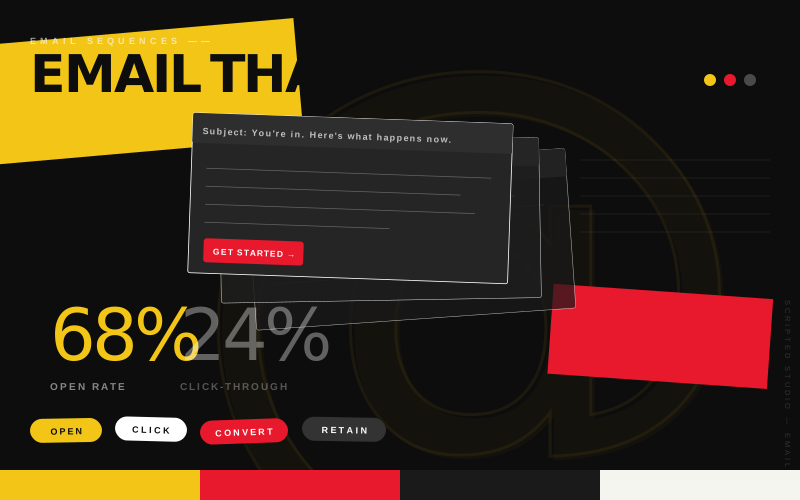
Open rates are a health signal, not a success metric. What you are measuring is: are users completing the activation event? Are they moving from free to paid? Are they booking calls?
The best sequences are built backward from those events. What does a user need to believe to take that action? What evidence supports that belief? What experience creates it? The email sequence is the delivery mechanism for all three.
Written well, it is your most efficient sales channel.
James Whitfield
Senior Copywriter
James is a conversion copywriter who blends editorial craft with data-driven strategy. He has written for B2B SaaS brands, venture-backed startups, and global agencies.